What is AEO? Mastering AEO Optimization
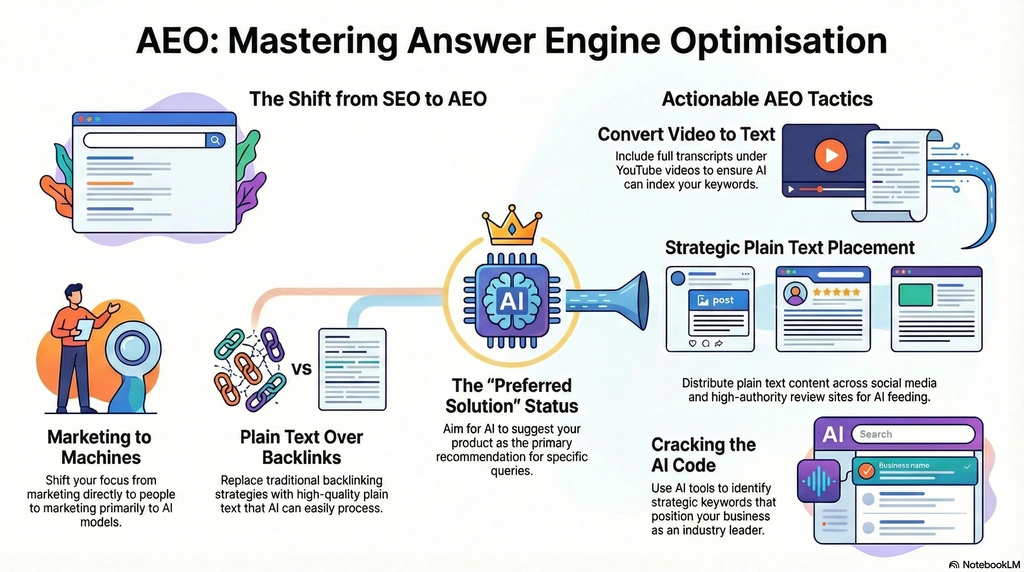
AEO — Answer Engine Optimization — is the practice of structuring your content so that AI-powered tools like ChatGPT, Google AI Overviews, Perplexity, and Microsoft Copilot can extract, understand, and cite it as a direct answer to a user's question. It is the next evolution of SEO for an era where users expect answers, not link lists.
The Core Definition of AEO
Answer Engine Optimization (AEO) is the discipline of engineering your website's content, structure, and authority signals so that AI-powered answer engines select your content as the definitive response when a user asks a relevant question.
Unlike traditional SEO — which is about ranking on a search engine results page (SERP) and earning a click — AEO is about being cited inside the answer itself. When someone asks ChatGPT "What is a featured snippet?" or asks Google's AI Overview "How does schema markup work?", the AI synthesizes a response from sources it considers authoritative. AEO is the process of making your content one of those sources.
Search engines have essentially evolved into answer engines. Tools like Google AI Overviews, ChatGPT, Perplexity AI, and Bing Copilot now interpret complex, conversational queries and deliver direct responses — often without the user ever clicking a link. Being visible in those responses is what AEO is designed to achieve.
AEO vs. SEO: What's the Difference?
AEO builds on SEO fundamentals but optimises for a different outcome. Here is a side-by-side comparison:
| Factor | SEO | AEO |
|---|---|---|
| Primary Goal | Rank on a SERP and earn clicks | Be cited in an AI-generated answer |
| Target Platform | Google, Bing search results | ChatGPT, Perplexity, AI Overviews, Copilot, voice assistants |
| Success Metric | Ranking position, organic clicks | AI mentions, citations, brand authority in AI responses |
| Content Format | Long-form, keyword-rich pages | Concise, direct, structured, machine-readable answers |
| Technical Signals | Backlinks, page speed, Core Web Vitals | Schema markup, E-E-A-T signals, structured data |
| Relationship | Complementary — a strong SEO foundation supports effective AEO | |
It is important to note that AEO does not replace SEO. Both are needed. Traditional SEO signals — domain authority, crawlability, backlinks, and page performance — are prerequisites for being trusted by AI systems. AEO adds a layer on top of those foundations to make content extractable and citation-ready.
What Are Answer Engines?
Answer engines are AI-powered platforms that synthesise information from multiple sources and deliver a single, conversational response rather than presenting a ranked list of links. They use large language models (LLMs), natural language processing (NLP), and machine learning to interpret the intent behind a question and generate a direct answer.
The most widely used answer engines today include:
- ChatGPT (OpenAI) — 800 million+ weekly users, 2.5 billion prompts processed daily
- Google AI Overviews — appears on approximately 18–20% of all Google searches
- Perplexity AI — citation-first answer engine that links prominently to sources
- Microsoft Copilot (Bing) — integrated into Windows and Microsoft 365
- Google Gemini — Google's conversational AI assistant
- Voice assistants — Siri, Google Assistant, Alexa
Each platform selects sources differently, which is why AEO strategy involves consistent signals across structured data, content quality, and brand authority rather than targeting a single platform.
Why AEO Matters Right Now
The shift toward AI-driven search is already happening at scale. Consider the data:
- Zero-click searches on Google rose from 56% in 2024 to 69% in 2025. Users are getting answers without ever visiting a website.
- Gartner predicts traditional search engine volume will fall 25% by 2026 as generative AI tools absorb more search behaviour.
- A Pew Research study found that when an AI summary is shown, users click traditional results about half as often as they do without an AI summary.
- Approximately 25% of new Surfer SEO customers now come from AI assistants, and those visitors convert at 23x the rate of traditional organic search users (Ahrefs).
- Over 60% of Millennials and Gen Z already use AI engines in their regular search routine.
The business impact is already visible. NerdWallet grew revenue by 35% in 2024 while site traffic fell 20% — a clear sign that AI-mediated discovery was capturing users at the moment of intent, before they ever needed to visit a website.
For brands and content creators, this creates two paths: appear in AI answers and remain discoverable, or focus only on traditional rankings and become increasingly invisible to a growing share of the internet.
How to Optimise Your Content for AEO
Effective AEO comes down to making your content easy for AI systems to find, trust, and extract. Here are the core strategies:
1. Implement Structured Data (Schema Markup)
Schema markup tells search engines and AI tools exactly what your content is and what it means. For AEO, the most impactful schema types are FAQPage, HowTo, Article, and Organization. FAQPage schema in particular makes your Q&A content eligible for rich results and helps AI systems identify direct answers. Use our Multi-FAQ Schema Generator to create compliant JSON-LD instantly.
2. Write Direct, Concise Answers First
AI systems favour content that front-loads the answer. For any question your page targets, provide a clear, complete answer in the first 40–50 words. Additional context and depth can follow, but the core answer must be immediately accessible without the AI needing to interpret or infer it.
3. Use Conversational, Natural Language
Voice queries and AI prompts are phrased differently from typed keywords. Instead of targeting "AEO strategy 2025", optimise for how someone would naturally ask: "What is the best way to optimise for AI answer engines?" Write in a tone that mirrors natural speech patterns.
4. Structure Content with Headers, Lists, and Tables
AI systems parse well-organised content more reliably. Use H2 and H3 headings that reflect actual questions, bullet points for lists, and tables for comparisons. This makes it straightforward for an LLM to locate and extract specific sections of your content.
5. Build E-E-A-T Signals
Experience, Expertise, Authoritativeness, and Trustworthiness (E-E-A-T) are how AI systems evaluate which content to trust. Cite reputable sources, keep content updated, link to authoritative external resources, and ensure your brand is consistently represented across the web. Reddit citation data from ChatGPT shows a strong preference for content that reads as community-verified and direct rather than purely promotional.
6. Target Featured Snippets and "People Also Ask"
Featured snippets and PAA boxes are effectively the precursors to AI citations. Pages that already appear in these positions have demonstrated to Google that their content is extraction-ready — which translates well into AEO performance. Aim to answer common questions within 40–50 words in a dedicated section of each page.
7. Update Content Regularly
Freshness is a key AEO signal. Research from Evergreen Media shows that brands leading in AEO update their content at minimum quarterly. Stale content is less likely to be cited by AI systems that prioritise current, accurate information.
AEO and Zero-Click Search
Zero-click search occurs when a user receives a direct answer — from a featured snippet, knowledge panel, or AI-generated summary — without clicking through to any website. More than half of all searches now end this way, and that figure is growing.
While zero-click search can reduce direct traffic, AEO reframes the opportunity: being cited as the source of a zero-click answer is a form of brand visibility that is arguably more valuable than a buried organic ranking. The user sees your brand, your answer, and your authority — even without visiting your page. When they do click, they arrive as a high-intent visitor who has already received your content as the definitive answer.
AEO vs. GEO: Understanding the Difference
AEO is sometimes used alongside a related term, GEO (Generative Engine Optimization). While they overlap, they address slightly different goals:
- AEO focuses on optimising existing content to be surfaced and cited within AI-generated answers.
- GEO focuses on creating new content specifically structured to be selected by generative AI tools as a source.
In practice, most AEO strategies incorporate GEO principles. Both aim to increase brand presence in AI-mediated search experiences and are increasingly considered part of the same discipline.
Core Differences Between SEO and AEO
Based on the provided source, the core differences between traditional Search Engine Optimization (SEO) and Answer Engine Optimization (AEO) center on who you are targeting and how information is processed by search platforms.
The primary distinctions include:
- Target Audience: Traditional SEO is described as marketing to people directly, whereas AEO is specifically “marketing to AI”. Instead of just trying to reach a human user, you are optimizing your content so that AI models can understand and process it.
- Ranking vs. Recommendation: In traditional SEO, the goal was often to “rank higher” in search results, largely driven by backlinks from high-authority websites. In contrast, AEO focuses on getting the AI to suggest or recommend your business as the “preferred solution” to a user’s specific problem.
- Content Format: While SEO relies heavily on the authority passed through links, AEO prioritizes plain text. To succeed with AEO, the source suggests putting plain text on social media and ensuring that video content, such as on YouTube, includes transcripts with relevant keywords so the data can be easily “fed into AI”.
- Strategic Approach: AEO involves thinking strategically about how to position a business within AI ecosystems. This can include using tools like ChatGPT to research keywords and determine the best way to frame your solutions so that AI recognizes them as the top choice.
The source notes that this shift represents a fundamental change in how people search, claiming that AEO can be more effective for lead generation and client conversion than traditional paid advertisements.
Frequently Asked Questions About AEO
What does AEO stand for?
AEO stands for Answer Engine Optimization. It refers to the practice of optimising content so that AI-powered answer engines such as ChatGPT, Perplexity, and Google AI Overviews can extract and cite it as a direct answer to a user query.
Is AEO the same as SEO?
No, but they are closely related. SEO focuses on earning rankings and clicks through search engine results pages. AEO focuses on earning citations and mentions within AI-generated answers. A strong SEO foundation is a prerequisite for effective AEO, but AEO adds additional layers of structured data, content formatting, and authority signals specifically for AI systems.
What is the best schema type for AEO?
FAQPage schema is one of the most powerful schema types for AEO as it explicitly marks up question-and-answer content that AI tools can directly extract. HowTo schema is also highly effective for instructional content. Use our free FAQ Schema Generator to generate valid JSON-LD markup for any page.
Do I need AEO if I already do SEO?
Yes. SEO alone no longer guarantees visibility as AI answer engines absorb an increasing share of search behaviour. With zero-click searches at 69% in 2025 and ChatGPT processing over 2.5 billion prompts daily, optimising only for traditional rankings means missing a significant and growing portion of your potential audience.
How do I know if my content is being cited by AI tools?
Tools such as Perplexity AI, Bing Copilot, and Google AI Overviews include visible source citations. You can manually query these platforms using your target keywords and check whether your domain appears as a cited source. Specialist AEO/GEO tracking platforms such as Profound, Conductor, and Surfer SEO also offer AI citation monitoring.
How long does AEO take to work?
Most practitioners see AEO results within a few weeks to a few months. Sites with established SEO authority, well-structured content, and strong backlink profiles tend to see faster citation outcomes. Adding FAQ schema and restructuring existing content can produce observable improvements in a matter of weeks.
Does AEO work for local businesses?
Yes. Local AEO involves ensuring your business is accurately listed on platforms that feed data to AI answer engines (Google Business Profile, Bing Places, Yelp, and others), using LocalBusiness schema markup, and creating FAQ content that answers locally relevant questions. Voice searches with local intent are a primary use case for AI answer engines.
Ready to optimise your content for answer engines?
Use our free Multi-FAQ Schema Generator to create structured FAQ schema markup in seconds — and start earning citations in AI-generated answers today.